
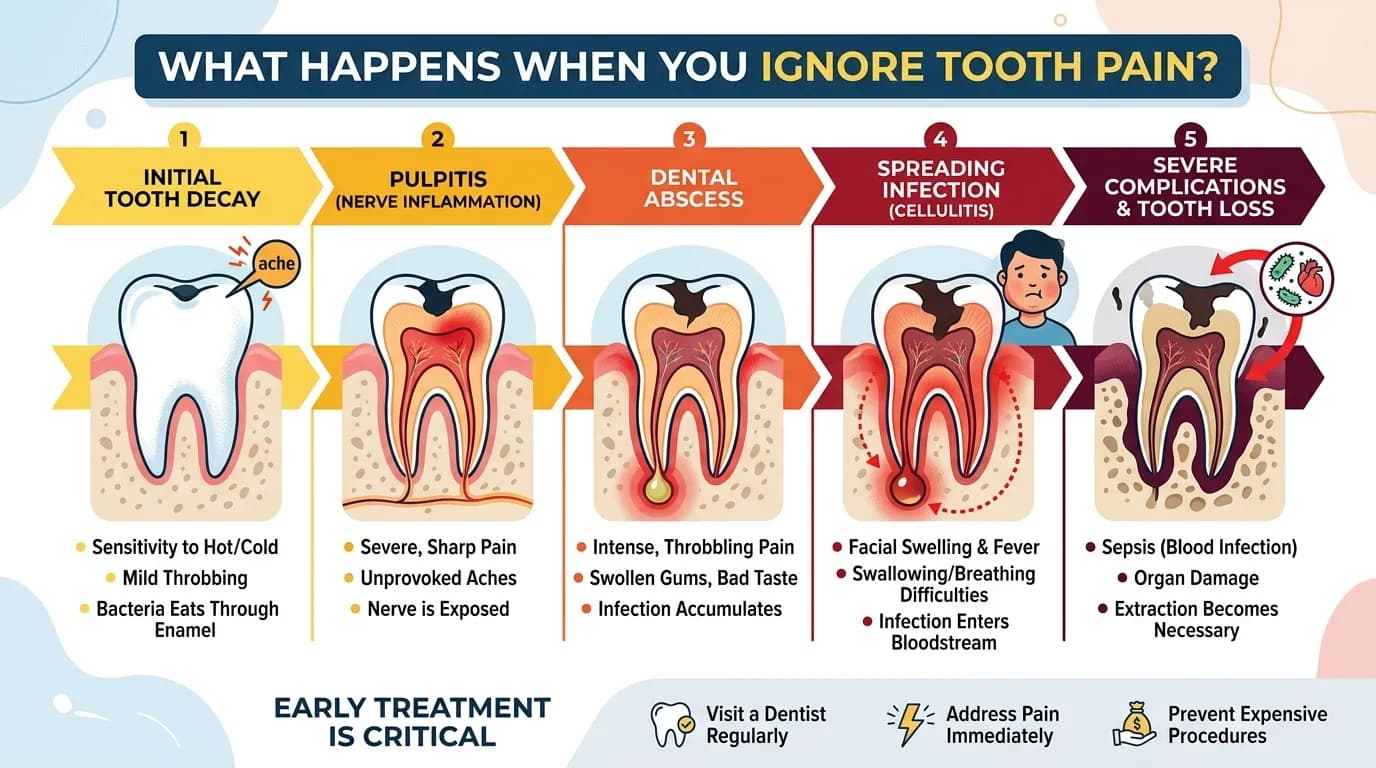
What Happens When You Ignore Tooth Pain? A Timeline of What Dental Problems Look Like at Each Stage
Tooth pain is one of the few symptoms that can push even calm people into panic. But it is also one of the easiest symptoms to delay—especially if it comes and goes.
This article lays out a realistic timeline of what can happen when you ignore pain: the tooth decay stages, the transition intotooth infection symptoms, and how a problem can become adental abscess. It is written for patients and dentists: patients get clarity and action steps; dentists get a narrative that helps with education and triage.
Important note: Pain is not a perfect severity gauge
Some deep problems hurt a lot. Others barely hurt until they suddenly do. So use this timeline as pattern recognition—not diagnosis.
Stage 0: “Nothing hurts” (but decay can still be forming)
Early enamel changes often have no symptoms. This is why routine exams matter.
Stage 1: Early cavity symptoms (days to weeks)
The first noticeable cavity symptoms are often subtle:
- Quick zing with cold or sweet
- Occasional sensitivity that stops fast
- Food catching in the same spot
At this stage, treatment is usually simpler and less invasive.
Stage 2: Dentin involvement (weeks to months)
As decay extends beyond enamel, sensitivity often lasts longer and can be triggered by temperature or chewing.
Stage 3: Pulp irritation (variable timeline)
This is where patients often start describing true “toothache.” Pain can throb, wake them at night, or flare after hot drinks.
For dentists, this is frequently the transition from “filling” pathways to endodontic evaluation.
Stage 4: Infection and tooth infection symptoms
When bacteria reach the pulp and beyond, tooth infection symptomscan appear:
- Persistent throbbing pain
- Bad taste or drainage
- Tenderness to touch or biting
- Swelling near the tooth or gumline
Stage 5: Dental abscess (urgent)
A dental abscess is a pocket of infection that can create pressure, swelling, and systemic risk.
Common tooth abscess symptoms include:
- Facial swelling
- Fever or feeling unwell
- Swollen lymph nodes
- Severe pain or, sometimes, a sudden reduction in pain after drainage
This is not a “wait and see” situation. Seek urgent dental care.
What Patients Should Do (Fast)
- Use DentalShelter's 3D model to identify the exact tooth and symptom.
- Then locate a clinic using Nearby Practices before it gets worse.
What Dentists Gain (Better Prepared Patients)
DentalShelter sends better-prepared patients who already understand their symptom stage and can describe location and triggers more clearly.
Recommended Next Reads
- Emergency Dentist Near Me: What to Do in the Next 30 Minutes
- Gum Disease Symptoms: How to Tell If Your Gums Are Trying to Warn You
Patients: Use DentalShelter's 3D model to identify the exact tooth and symptom, then locate a clinic before it gets worse.
Dentists: DentalShelter sends better-prepared patients who already understand their symptom stage.
Frequently Asked Questions
What are the stages of tooth decay?
The stages of tooth decay typically progress from enamel changes with few symptoms, to dentin involvement (sensitivity), to pulp irritation (toothache), and then infection/abscess if untreated.
What are tooth infection symptoms?
Tooth infection symptoms can include throbbing pain, swelling, a bad taste, drainage, and tenderness to biting. Fever or spreading swelling is a reason to seek urgent care.
How do I know if I have a dental abscess?
A dental abscess often presents with swelling, severe pain, tenderness, and sometimes fever or a bad taste/drainage. A dentist must confirm it, but it should be treated as urgent.
Can tooth pain go away and still be serious?
Yes. Pain can fluctuate. In some cases, nerve damage or drainage can reduce pain temporarily while infection remains.