Why Dentists Are Asking Patients to Use 3D Mouth Models Before Appointments (And How It's Cutting Consultation Time)
Every dentist knows the pattern: the patient sits down, points vaguely at a jaw quadrant, and says “it hurts somewhere around here.” You ask about hot/cold, biting pressure, duration, and timing. Ten minutes later, you have a rough idea—maybe. Multiply that by a full schedule and you have a real operational problem, not just a communication problem.
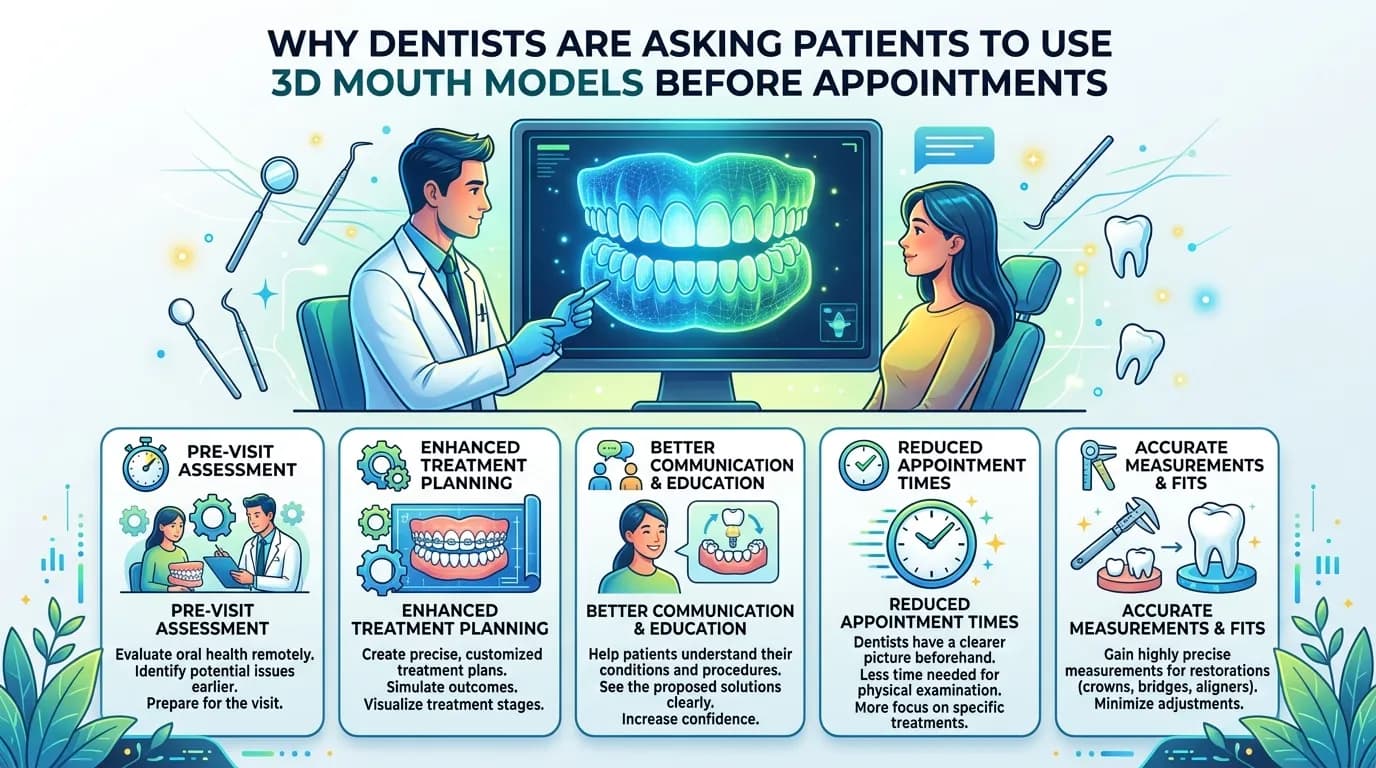
That is why more practices are experimenting with pre-visit symptom documentation—especially interactive 3D mouth models. When used correctly, they improve dental patient communication, support better triage, and meaningfully increase dental practice efficiencywithout adding a new “system” for your team to manage.
The Real Problem: Dentistry Is Spatial, but Intake Is Text
Most intake workflows are built around text fields and generic questions. But dentistry is location-based:
- Which tooth? Which surface?
- Is it gingival, periodontal, or pulpal in character?
- Localized swelling vs. generalized inflammation?
Patients rarely have the vocabulary to express that. A 3D model gives them the one thing they do have: the ability to point.
How 3D Mouth Models Improve Dental Patient Communication
A good 3D mouth model is not just a visual. It is a structured communication layer that produces cleaner inputs for your clinical questions.
1) Location specificity comes first
If a patient can reliably identify “upper right first molar” vs. “somewhere on the right,” your exam starts with focus.
2) Symptom descriptors become more consistent
When the interface encourages described choices (throbbing vs. sharp, worse with cold vs. biting), the output becomes easier to triage.
3) Fewer “reset” questions
Pre-visit summaries reduce the need for repeated clarification, especially for anxious patients, parents, and patients with limited health literacy.
Dental Practice Efficiency: Where the Time Savings Actually Come From
No tool eliminates diagnosis time. But the best tools reduce low-value chair-time.
Operational wins practices report
- Faster triage: Front desk or clinical coordinators can route “same-day urgent” vs. “routine” more reliably.
- Better scheduling: If a patient reports swelling + severe pain, you schedule differently than if it is mild cold sensitivity.
- Shorter consult loops: The dentist starts with context, not a blank slate.
- Higher case acceptance: When patients feel “understood,” they are more likely to proceed with recommended care.
Patient Education Dental: The Hidden Benefit
“Patient education dental” is usually treated as a chairside exercise. But education works best when it starts before the appointment.
A 3D model helps patients understand basic structure (tooth numbering, surfaces, gumline) and makes your explanations easier to land.
How to Implement a 3D Mouth Model Without Adding Work for Staff
If your team has to “manage” the tool, adoption fails. The simplest implementation is:
- Add it to your appointment confirmation messages: “Before your visit, please pinpoint the tooth/area and describe symptoms using our free 3D mouth model.”
- Ask patients to bring the summary on their phone.
- Optionally: have them paste the summary into your online intake form.
That workflow supports digital dental tools without creating an integration project.
Where DentalShelter Fits
DentalShelter is built to help patients be more specific before they reach you. Patients use a 3D mouth model to identify the tooth or gum area and describe symptoms, then use Nearby Practices to find a clinic.
When your practice appears, you are more likely to see a patient who is ready to explain “what” and “where” in plain language.
Internal Links (Suggested Reads for Your Team)
- For the patient-facing version, consider linking to: Tooth Pain but No Idea What's Wrong? This 3D Mouth Tool Helps You Figure It Out Before Seeing a Dentist
- For the tech overview: What Is a Dental Diagnosis Tool?
(Dentists)
List your practice on DentalShelter so patients arrive already prepared to describe their problem.
Frequently Asked Questions
Does a 3D mouth model replace a clinical exam?
No. It improves pre-visit communication and helps you start the visit with a better location + symptom description. Diagnosis still requires your exam and imaging as appropriate.
How does this improve dental consultation time?
It reduces the intake back-and-forth by giving you (and the team) a clear starting point: the likely tooth/area and the patient’s symptom pattern.
Will my staff have more work?
Not if you keep it simple: ask patients to use the model and bring the summary on their phone. No new system to maintain.
What types of cases benefit most?
Urgent pain, unclear tooth localization, gum swelling, and cases with high anxiety or low health literacy tend to see the biggest benefit.